
At a glance
- Moves into Attio from Salesforce, HubSpot or Affinity, and out of Attio when a team changes CRM.
- Maps objects, attributes, lists and owners, and tests a sample import before the full move.
- Syncs Attio companies, people, deals, notes and lists into Snowflake, BigQuery or Databricks.
- Rig is an independent integrator, not a listed Attio Expert.
Records, logic and owners
Source to target definitions
Counts, totals and access
Sign-off and rollback plan
What Rig does for Attio teams
Rig handles the data and systems work around Attio. That means the migration into Attio and, when needed, out of it; the data model, with objects, attributes, lists and custom objects designed against the way your team sells; a scheduled sync of Attio into your warehouse; and governed access to that data for reporting and AI assistants. Your team owns the workspace and approves each mapping. Rig engineers do the build, the loads and the checks.
Migration paths into and out of Attio
Each path has its own page with the object mapping, the known traps and the checks Rig runs. Start with the system you are leaving.
Attio data in your warehouse
Rig Ingest syncs your Attio companies, people and deals into your warehouse on a schedule, along with notes, meetings, lists and list entries. Each deal keeps its stage history, so time in stage still works after a pipeline is renamed. Custom attributes arrive as columns automatically. Separate Attio custom objects are not synced by Rig Ingest today.
How a migration runs in Rig
Rig maps the systems and data across your estate, connects the source and target, and maps one schema to the other with previews of real records. Rig engineers agree the objects and history in scope with your team, prepare the destination and rehearse the load before they reconcile the results. Sign-off, cutover and follow-up tasks sit in the same migration workspace.
Agree a timeline against the actual scope
The table gives a planning allowance for each phase, and the assessment turns it into a dated plan for the whole project. Large estates need several waves, and application configuration can add time.
| Phase | Initial planning allowance | Exit check |
|---|---|---|
| Assessment | 3 to 5 working days | Owners, access and inventory agreed |
| Sample and mapping | 5 to 10 working days | Sample records and exceptions reviewed |
| Build and parallel validation | 2 to 6 weeks per wave | Counts, totals and permissions accepted |
| Final sync and cutover | 1 to 3 working days per wave | Business owner signs off; rollback remains available |
Keep the evidence for each migration wave
For each wave you receive the source-to-target mappings, a reconciliation report, an exception log and a cutover checklist. The checks cover duplicates, missing relationships, deleted records, time zones and permissions as well as headline totals, and the old system stays available until the agreed retention and rollback checks pass.
Where Rig may fall short
A small workspace with standard objects may only need Attio’s own CSV import, and you can do that yourself. Rig does not resell Attio licences, and it does not run sales process consulting or sales training. If you need Attio custom objects in your warehouse, confirm the current Rig Ingest coverage first, because those objects are not synced today.
Inside Rig Migrate
Run the migration in Rig, from the systems map to cutover
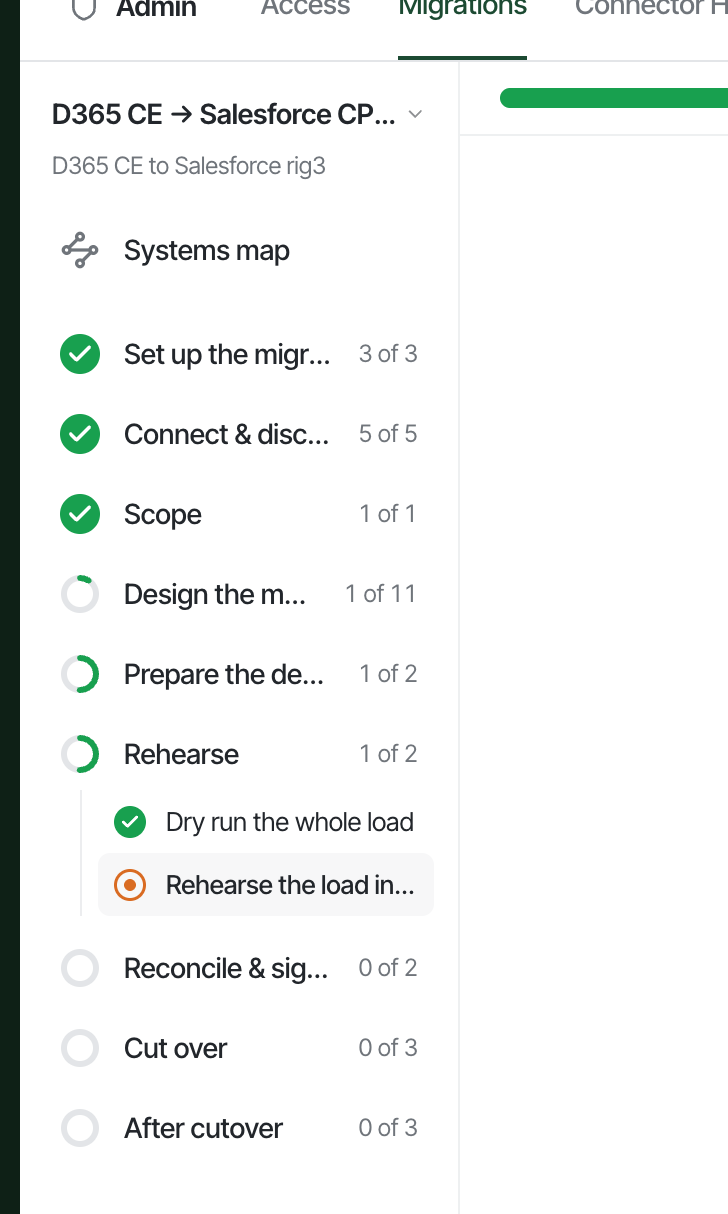
Rig natively maps systems and data across your IT estate, connects source and target systems, scopes the move and maps one schema to another. The same migration workspace tracks destination preparation, rehearsals, reconciliation, sign-off and the work after cutover, so your team can review the decisions and progress in one place.
Map the IT estate
Map systems, data and integration flows across the IT estate. See which reports, processes and teams depend on the systems you plan to change.
Set up the migration
Create the migration in Rig and record the source, destination and work to deliver. Keep the migration tasks and progress together.
Connect and discover
Connect the source and target systems, then inspect their schemas and available data. Confirm access before deciding how each object will move.
Scope the work
Choose the objects, fields and history to migrate. Record what stays, what changes and the dependencies the migration needs to preserve.
Map schema to schema
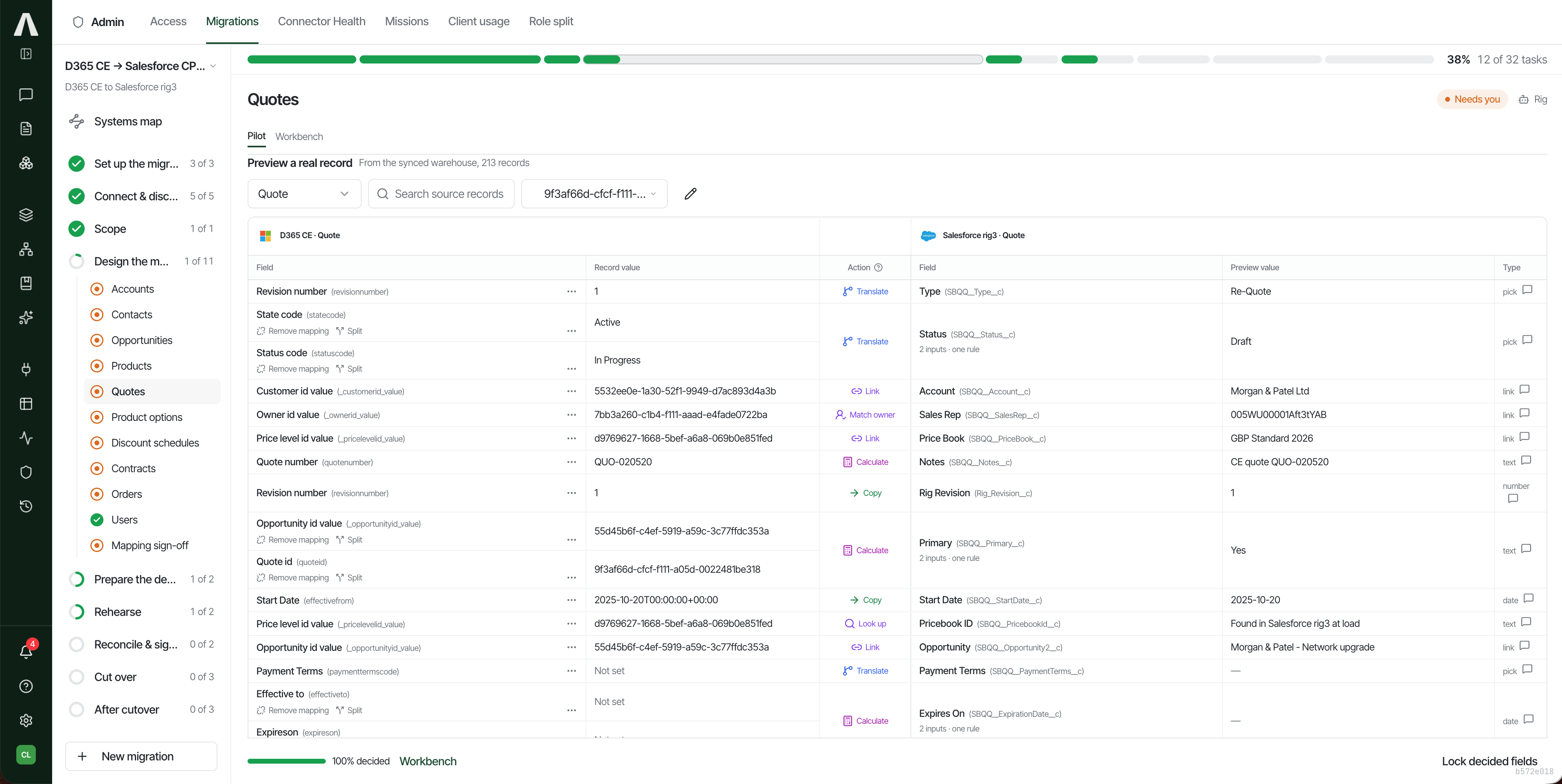
Map source objects and fields to the target schema. Preview records and review rules to copy, translate, calculate, link, look up and match owners.
Prepare the destination
Track the target preparation needed before loading data, including its configuration and the relationships your mapped records will use.
Rehearse the load
Dry run the whole load and rehearse it in the destination environment. Review the results and resolve issues before the production cutover.
Reconcile and sign off
Compare source and target records, relationships and business totals. Review exceptions with the system owners and record acceptance before proceeding.
Cut over
Work through the agreed cutover tasks in Rig. Coordinate the final load and user switch with the people who own the systems.
Check after cutover
Track the checks after the switch, confirm that reporting and processes work, and resolve outstanding issues before retiring the old setup.
Inspect source values and target previews
The migration workbench shows source fields, target previews and the rule for each mapping. Your team can review translated values, linked records and calculated fields before signing off the mapping and rehearsing the load.
Common questions
Who can help me migrate from HubSpot to Attio?
Attio lists implementation firms in its Experts directory, and independent integrators such as Rig also run these moves. Rig maps HubSpot companies, contacts, deals, activities and custom objects to Attio, tests a sample import, then migrates in checked waves with a reconciliation report for each one. Pipeline history that the new workspace does not need stays queryable in your warehouse.
What is the best Attio implementation partner for a mid-market team?
Choose a partner that can show the data work as well as the workspace setup: how it maps custom objects, tests a sample import, reconciles record counts and keeps history. A mid-market team should also check that the partner can sync Attio into the warehouse so reporting and AI tools keep working. Ask every partner, Rig included, for a sample mapping before you sign.
How difficult is it to migrate custom objects from Salesforce to Attio?
It is harder than moving standard objects. Attio can model custom objects, but Salesforce record types, lookups, junction objects and formula fields have no one-to-one equivalent, so each one needs a design decision. Rig maps each custom object and its relationships, imports a sample, and checks the result with the people who use those records before the full move.
How do I get Attio data into Snowflake?
Connect Rig to your Snowflake account, then create an integration in Attio with read access to records, notes and lists, and connect it in Rig. Rig Ingest then loads companies, people, deals, notes, meetings, lists and list entries into Snowflake on a schedule, with each deal's stage history. The same steps work for BigQuery and Databricks.
Is Rig an official Attio partner?
No. On 24 November 2026 Rig is not listed in Attio’s Experts directory, and nothing on this page describes an Attio partner programme. Rig is an independent data and systems integrator that implements and migrates to Attio for mid-market teams and syncs Attio into their warehouse. If that listing status changes, this answer will be updated to say so.
Sources and product details
Vendor information checked on 24 November 2026. Confirm current editions, licence terms and prices with the vendor before buying.