
At a glance
- Rig agrees a fixed delivery price after scoping the data, logic and integrations.
- Data moves in checked waves, with a parallel run where the systems allow it.
- History and permission tests are part of acceptance.
- Your system owners approve the mappings and the cutover.
Records, logic and owners
Source to target definitions
Counts, totals and access
Sign-off and rollback plan
Map the data and the logic it carries
The table is a starting inventory, and the target edition, customisations and API access decide the final mapping. Check each object even when the name matches, because an object with the same name can behave differently in the target.
| Source | Target or retained output | Checks and known traps |
|---|---|---|
| Databases and SQL Agent jobs | A supported SQL Server version, Azure SQL or your warehouse | Check compatibility level, collation, linked servers and job schedules. |
| SSIS packages | Warehouse pipelines, Rig Ingest or a supported SSIS version | Inventory connections, credentials, package parameters and failure handling. |
| SSRS reports and subscriptions | Power BI Report Server, Power BI paginated reports or rebuilt dashboards | Test parameters, pagination, exports and email subscriptions. |
| Logins, roles and row filters | Access policies on the target platform | Test each role with real users before cutover. |
What end of support means for SQL Server 2016
Microsoft’s Lifecycle Policy page lists the end of extended support for SQL Server 2016 as 14 July 2026, with the cut-off at 6:59 AM Pacific Time on 15 July. After that date Microsoft provides no patches or security updates for it unless you subscribe to Extended Security Updates, which cover critical security updates for up to three years, to 17 July 2029. The servers keep running, and your security and audit reviews will flag the unsupported version.
Upgrade, buy Extended Security Updates or move the workload
For each workload on SQL Server 2016 you can upgrade to a supported version, buy Extended Security Updates while you plan, or move the reports and pipelines to another platform. One estate can need all three, for example a database upgraded in place while old SSRS reports are retired or rebuilt.
| Option | When it fits | What to check |
|---|---|---|
| Upgrade SQL Server | The workload works and only the version is the problem | Compatibility level, deprecated features and Power BI Report Server licensing |
| Extended Security Updates | You need time to plan, up to 17 July 2029 | Enterprise or Standard edition, the latest service pack, and Software Assurance or Azure Arc, per Microsoft’s ESU FAQ |
| Move to Power BI or a warehouse | The reports and pipelines need changing anyway | Which reports still have readers and which SSIS jobs feed them |
Find out which SSRS reports and SSIS jobs still matter
Rig Map builds an inventory of the reports, datasets, subscriptions, packages and tables on the server, with the dependencies between them. Rig engineers add execution history from the report server log where it exists. That shows which reports have readers and which jobs feed them, so you move those and retire the rest.
How a migration runs in Rig
Rig maps the systems and data across your estate, connects the source and target, and maps one schema to the other with previews of real records. Rig engineers agree the objects and history in scope with your team, prepare the destination and rehearse the load before they reconcile the results. Sign-off, cutover and follow-up tasks sit in the same migration workspace.
Agree a timeline against the actual scope
The table gives a planning allowance for each phase, and the assessment turns it into a dated plan for the whole project. Large estates need several waves, and application configuration can add time.
| Phase | Initial planning allowance | Exit check |
|---|---|---|
| Assessment | 3 to 5 working days | Owners, access and inventory agreed |
| Sample and mapping | 5 to 10 working days | Sample records and exceptions reviewed |
| Build and parallel validation | 2 to 6 weeks per wave | Counts, totals and permissions accepted |
| Final sync and cutover | 1 to 3 working days per wave | Business owner signs off; rollback remains available |
Keep the evidence for each migration wave
For each wave you receive the source-to-target mappings, a reconciliation report, an exception log and a cutover checklist. The checks cover duplicates, missing relationships, deleted records, time zones and permissions as well as headline totals, and the old system stays available until the agreed retention and rollback checks pass.
Where Rig may fall short
A migration that only needs a supported CSV import may be simpler to do yourself. Sub-minute operational replication, a full ERP implementation and specialist application redesign need a separate scope or another provider. Where Rig Ingest moves the data, confirm connector coverage for each source before you commit.
Inside Rig Migrate
Run the migration in Rig, from the systems map to cutover
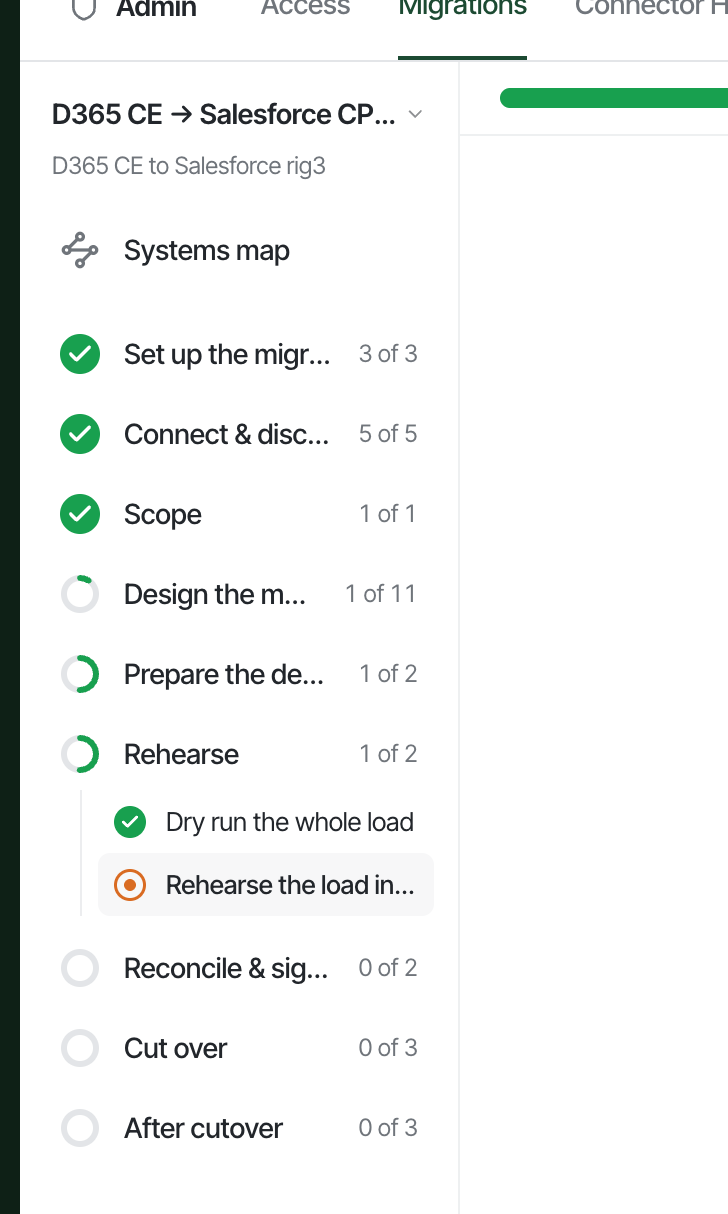
Rig natively maps systems and data across your IT estate, connects source and target systems, scopes the move and maps one schema to another. The same migration workspace tracks destination preparation, rehearsals, reconciliation, sign-off and the work after cutover, so your team can review the decisions and progress in one place.
Map the IT estate
Map systems, data and integration flows across the IT estate. See which reports, processes and teams depend on the systems you plan to change.
Set up the migration
Create the migration in Rig and record the source, destination and work to deliver. Keep the migration tasks and progress together.
Connect and discover
Connect the source and target systems, then inspect their schemas and available data. Confirm access before deciding how each object will move.
Scope the work
Choose the objects, fields and history to migrate. Record what stays, what changes and the dependencies the migration needs to preserve.
Map schema to schema
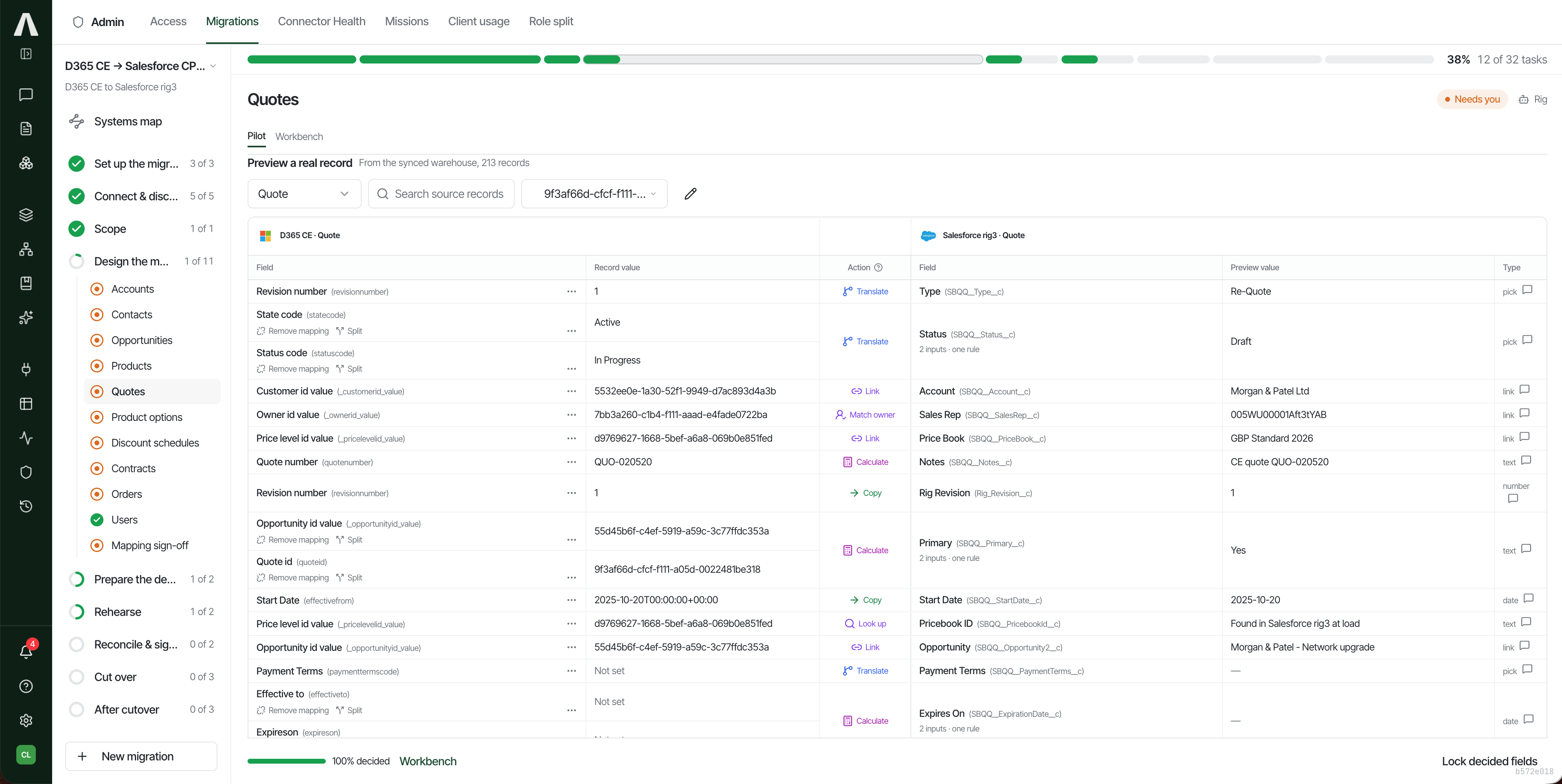
Map source objects and fields to the target schema. Preview records and review rules to copy, translate, calculate, link, look up and match owners.
Prepare the destination
Track the target preparation needed before loading data, including its configuration and the relationships your mapped records will use.
Rehearse the load
Dry run the whole load and rehearse it in the destination environment. Review the results and resolve issues before the production cutover.
Reconcile and sign off
Compare source and target records, relationships and business totals. Review exceptions with the system owners and record acceptance before proceeding.
Cut over
Work through the agreed cutover tasks in Rig. Coordinate the final load and user switch with the people who own the systems.
Check after cutover
Track the checks after the switch, confirm that reporting and processes work, and resolve outstanding issues before retiring the old setup.
Inspect source values and target previews
The migration workbench shows source fields, target previews and the rule for each mapping. Your team can review translated values, linked records and calculated fields before signing off the mapping and rehearsing the load.
Reporting migration at Birdie
Birdie reports rebuilding sales and marketing reporting in less than a day. Its team kept Snowflake and the existing Fivetran pipelines; retirement of the Looker licence is not confirmed.
Read the migration case studyCommon questions
When did SQL Server 2016 reach end of support?
Microsoft lists 14 July 2026 as the end of extended support for SQL Server 2016, and its Lifecycle Policy page shows the cut-off as 6:59 AM Pacific Time on 15 July 2026. Extended Security Updates are available until 17 July 2029.
Does SSRS on SQL Server 2016 stop working?
The report server keeps running after end of support. It no longer receives security updates unless you buy Extended Security Updates, so plan the upgrade or migration before a security review flags it.
Where should SSRS reports go after SQL Server 2016?
Paginated reports can move to Power BI Report Server or to Power BI paginated reports. Interactive summaries are better rebuilt on a governed model in Power BI or another BI tool, and reports nobody reads can be retired.
Who can buy Extended Security Updates for SQL Server 2016?
Microsoft’s ESU FAQ says Enterprise and Standard editions are eligible, on the latest service pack. Customers with Software Assurance can subscribe on-premises, and customers without it can get ESUs by moving to Azure or connecting to Azure Arc.
How much does a migration cost?
Rig maps the work and agrees a fixed delivery price before the migration starts. Source access, custom logic, history and the number of integrations affect the scope. Platform and third-party licence costs are agreed separately.
Can we keep reporting history?
Yes, where the source lets you extract it. You decide which history the target system needs and which stays in a governed archive, and Rig reconciles both against the original records.
How do you check that the data matches?
Rig compares record counts, identifiers, relationships and business totals for each wave. Every exception goes in a log, and the business owner has to accept the results before cutover.
Sources and product details
Vendor information checked on 20 November 2026. Confirm current editions, licence terms and prices with the vendor before buying.