
At a glance
- Rig scopes the data, logic and integrations before agreeing a fixed delivery price.
- Move in checked waves, with a parallel run where possible.
- Keep history and test permissions as part of acceptance.
- Your system owners approve the mappings and cutover.
Records, logic and owners
Source to target definitions
Counts, totals and access
Sign-off and rollback plan
Map the data and the logic it carries
This is a starting inventory. The target edition, customisations and API access determine the final mapping. An object with the same name can still behave differently.
| Source | Target or retained output | Checks and known traps |
|---|---|---|
| Products and price books | Target catalogue and pricing | Review bundles, currencies, effective dates and pricing rules. |
| Quotes and quote lines | Target quotes and line relationships | Reconcile discounts, rounding, tax inputs and approval outcomes. |
| Contracts and subscriptions | Target contracts and asset lifecycle | Test amendments, renewals, co-termination and billing handoffs. |
| Custom rules and integrations | Rebuilt application logic | Do not treat package objects as interchangeable. |
End of sale does not require an immediate migration
Salesforce says existing CPQ customers can continue using the product, add users and renew licences. Its investment has shifted toward Revenue Cloud. Confirm your contract and current product packaging with Salesforce. Revenue Cloud Advanced migration includes application redesign as well as data mapping.
Test the whole quote-to-cash process
Run representative new sales, amendments, renewals and cancellations through a sandbox. Compare quote totals and subscription dates, and test approvals, orders and billing handoffs. Agree who owns product configuration and pricing rules before delivery starts.
Connect, scope and run the migration in Rig
Rig natively maps systems and data across the IT estate, connects source and target systems and supports schema-to-schema mapping with record previews. Scope the objects and history, prepare the destination, then rehearse the load and reconcile the results. Track sign-off, cutover and follow-up tasks in the same migration workspace.
Agree a timeline against the actual scope
These are planning allowances for individual phases, not a promise for the whole project. Large estates need repeated waves, and application configuration can add time.
| Phase | Initial planning allowance | Exit check |
|---|---|---|
| Assessment | 3 to 5 working days | Owners, access and inventory agreed |
| Sample and mapping | 5 to 10 working days | Sample records and exceptions reviewed |
| Build and parallel validation | 2 to 6 weeks per wave | Counts, totals and permissions accepted |
| Final sync and cutover | 1 to 3 working days per wave | Business owner signs off; rollback remains available |
Keep the evidence for each migration wave
You receive the source-to-target mappings, a reconciliation report, an exception log and a cutover checklist. Test duplicates, missing relationships, deleted records, time zones and permissions as well as headline totals. Keep the old system available until the agreed retention and rollback checks pass.
Where Rig may fall short
Rig is a data infrastructure and implementation partner. A migration that only needs a supported CSV import may be simpler to do yourself. Sub-minute operational replication, a full ERP implementation and specialist application redesign need a separate scope or another provider. Confirm connector coverage before committing to Ingest.
Inside Rig Migrate
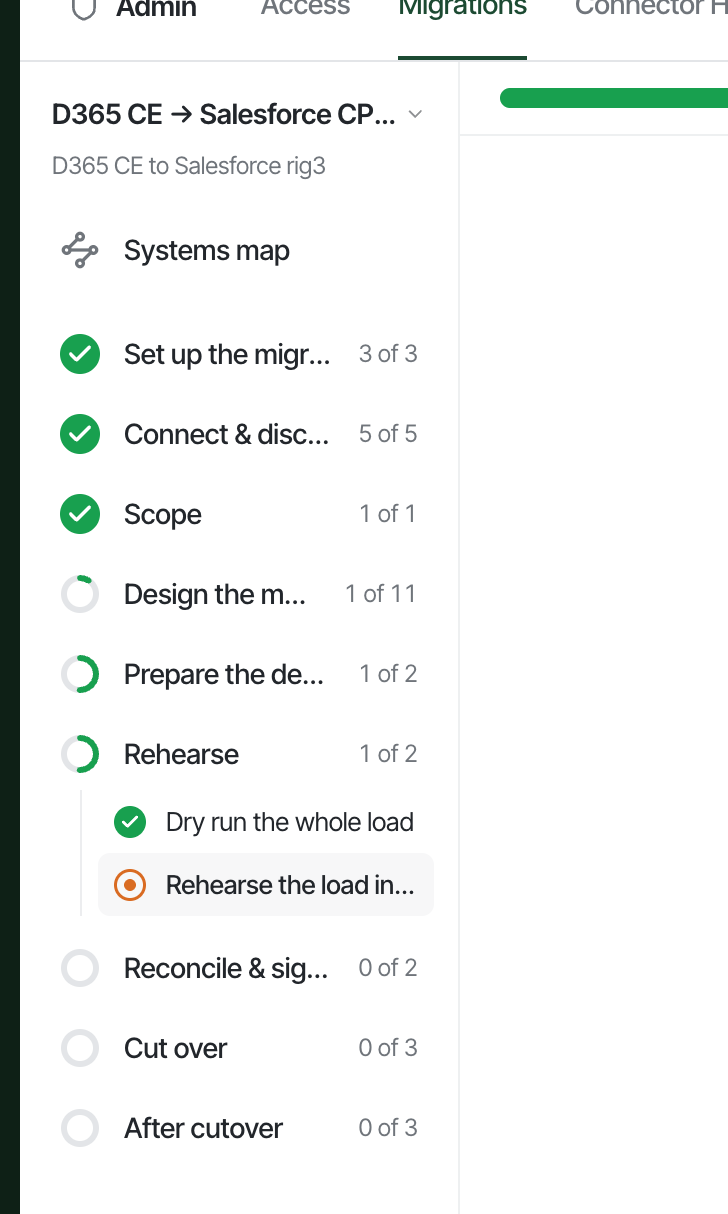
Run the migration in Rig, from the systems map to cutover
Rig natively maps systems and data across your IT estate, connects source and target systems, scopes the move and maps one schema to another. The same migration workspace tracks destination preparation, rehearsals, reconciliation, sign-off and the work after cutover, so your team can review the decisions and progress in one place.
Map the IT estate
Map systems, data and integration flows across the IT estate. See which reports, processes and teams depend on the systems you plan to change.
Set up the migration
Create the migration in Rig and record the source, destination and work to deliver. Keep the migration tasks and progress together.
Connect and discover
Connect the source and target systems, then inspect their schemas and available data. Confirm access before deciding how each object will move.
Scope the work
Choose the objects, fields and history to migrate. Record what stays, what changes and the dependencies the migration needs to preserve.
Map schema to schema
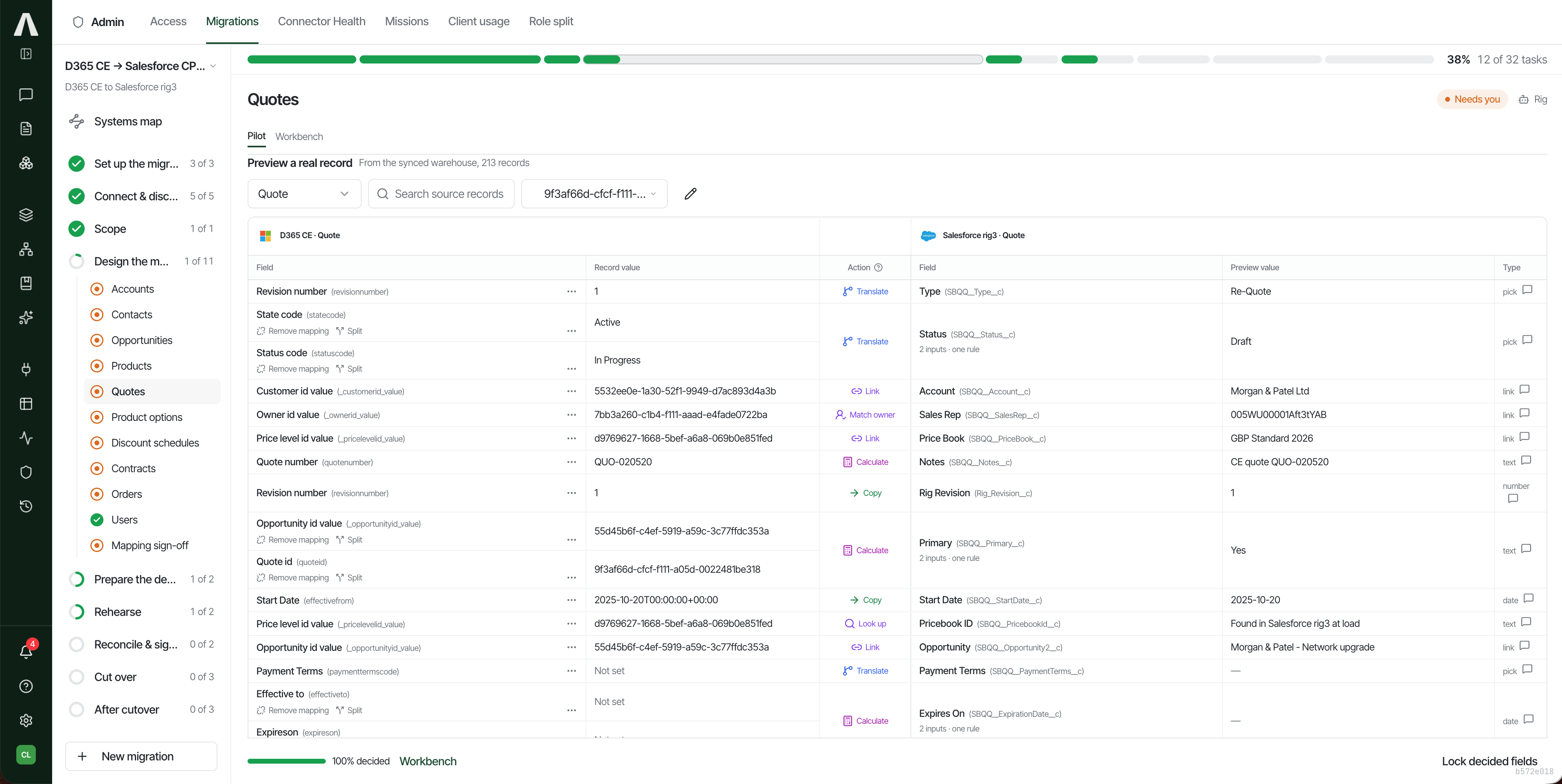
Map source objects and fields to the target schema. Preview records and review rules to copy, translate, calculate, link, look up and match owners.
Prepare the destination
Track the target preparation needed before loading data, including its configuration and the relationships your mapped records will use.
Rehearse the load
Dry run the whole load and rehearse it in the destination environment. Review the results and resolve issues before the production cutover.
Reconcile and sign off
Compare source and target records, relationships and business totals. Review exceptions with the system owners and record acceptance before proceeding.
Cut over
Work through the agreed cutover tasks in Rig. Coordinate the final load and user switch with the people who own the systems.
Check after cutover
Track the checks after the switch, confirm that reporting and processes work, and resolve outstanding issues before retiring the old setup.
Inspect source values and target previews
The migration workbench shows source fields, target previews and the rule for each mapping. Your team can review translated values, linked records and calculated fields before signing off the mapping and rehearsing the load.
Reporting migration at Birdie
Birdie reports rebuilding sales and marketing reporting in less than a day. Its team kept Snowflake and the existing Fivetran pipelines; retirement of the Looker licence is not confirmed.
Read the migration case studyCommon questions
What moves in this migration?
Salesforce CPQ is end of sale. Existing customers remain supported, so you can assess the move before choosing a cutover date. Rig scopes the data and reporting work for CPQ to Revenue Cloud migration with your application owners.
How much does a migration cost?
Rig maps the work and agrees a fixed delivery price before the migration starts. Source access, custom logic, history and the number of integrations affect the scope. Platform and third-party licence costs are agreed separately.
Can we keep reporting history?
Yes, where the source permits extraction. Agree which history belongs in the target system and which stays in a governed archive. Reconcile both against the original records.
How do you check that the data matches?
Compare record counts, identifiers, relationships and business totals for each wave. Record exceptions and require the business owner to accept the results before cutover.
Will both systems run during the move?
Plan a parallel run where the systems and licences allow it. Agree the source of truth, final changes, rollback conditions and the point at which users switch.
Who does the implementation?
Rig engineers work with your system owners. Your team approves mappings, permissions and acceptance checks. Application configuration and specialist ERP or CPQ work must be included in scope or assigned to your application partner.
Is there a guaranteed completion date?
The assessment produces a dated plan. The planning ranges on this page are estimates, subject to access, data quality, target readiness and user acceptance.
Sources and product details
Vendor information checked on 11 November 2026. Confirm current editions, licence terms and prices with the vendor before buying.